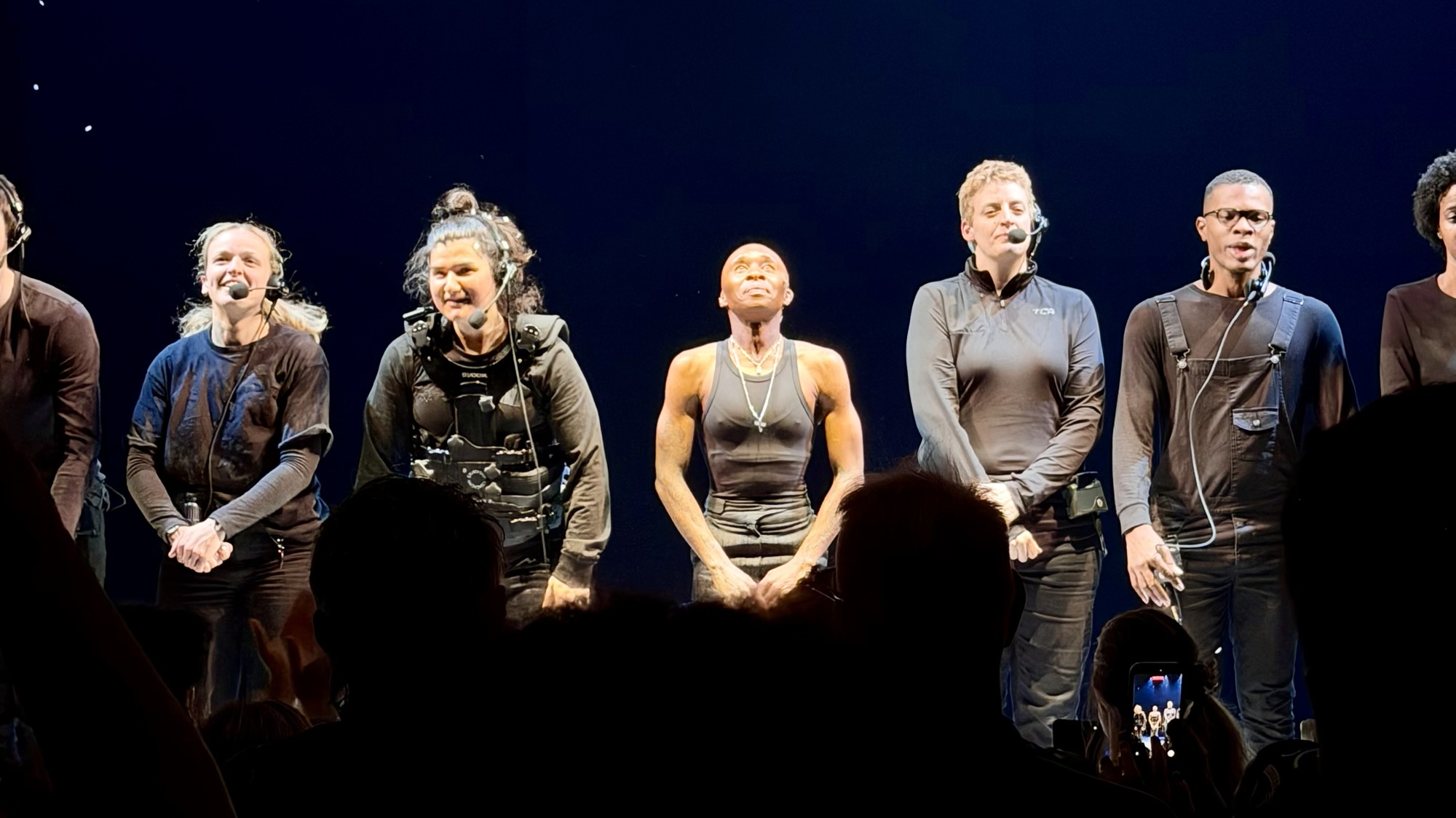

There is a specific kind of electricity that only hits the West End when one of our own returns home a conqueror. This April, the Noël Coward Theatre was the epicenter of that energy as Cynthia Erivo – our Tony, Grammy, and Emmy-winning superstar – stepped back onto London boards for the first time in a decade. But this wasn’t a standard homecoming; it was a technical “triple Lutz” of a production. Directed by the visionary Kip Williams, this Dracula is the final chapter of his Gothic Cine-Theatre Trilogy, following the massive success of The Picture of Dorian Gray.
Walking into the Noël Coward, you immediately feel an event theatre vibe. The stage is a skeletal playground of fluorescent markers, dominated by a screen so massive it makes the theatre feel like a high-end film studio. The buzz in the lobby was a mix of awe and skepticism: could one woman really play 23 roles? Could the cine-theatre style actually capture the dread of Stoker’s vampire? As a huge theatre fan myself, I was ready to see if Erivo’s return would be a show to die for or just a high-tech distraction.
Stoker’s Journals in the Digital Age
The narrative is a surprisingly faithful trip through the 1897 novel. Unlike many adaptations that turn Dracula into a linear action movie, Williams keeps the epistolary form – the diaries, the letters, and the newspaper clippings – front and center. We follow the harrowing journey of solicitor Jonathan Harker to Transylvania, the tragic decline of the socialite Lucy Westenra, and the desperate stand made by Mina Murray and the legendary Van Helsing.
The twist, of course, is that Erivo plays them all. One moment she is the “clipped” and professional Harker; the next, she is the “guttural” and magus-like Van Helsing with long, white Saruman-esque hair. The production reframes the Count not just as a Transylvanian intruder but as a manifestation of desire living within all the characters. It is a psychological hunt where the boundaries between the hunter and the hunted blur on screen, literally showing faces mutating into one another. It is tight, gripping storytelling that honors the book while feeling entirely modern.
A Trance-Like Descent into Madness
If you’re expecting Wicked-style showstoppers, think again. While Erivo is a musical legend, this is a play first and foremost. But don’t let that fool you – the soundscape by Clemence Williams is a relentless, 120-minute beast. The score is a mind-bending mix of Tchaikovsky, Chopin, and the avant-garde vibes of Björk, all stitched together with a hypnotic electronic pulse that turns the theatre into a gothic rave during the horror peaks.
The musical highlight, and the moment the entire audience held its breath, comes at the very end. After nearly two hours of speaking at a breakneck pace, Erivo finally lets her voice fly in a haunting, original melancholy torch song. It is a siren’s call that feels like an emotional bloodletting after the technical precision of the show. It’s a tantalizing snippet of the voice we love, used sparingly but effectively to punctuate the chilling finale. It was, quite simply, gravity-defying.
A “Cine-Theatre” Spectacle
The staging is where the production gets radical. A team of camera operators stalks Erivo across the stage, capturing every bead of sweat and twitch of a finger in rat’s-eye close-ups and bird’s-eye overheads. It reminded me of the brilliant Sunset Boulevard remake. But here, these live feeds are mixed in real-time with pre-recorded footage of Erivo playing other characters, allowing her to interact with herself on a massive scale.
The visual effects are jaw-dropping. We see Dracula crawling down walls and disappearing from digital mirrors right before our eyes. The screen itself is a character, shifting and slinking around the stage until it forms a massive, glowing crucifix for the final showdown. It is a hallucinatory experience that makes the Noël Coward feel three times its actual size. Some might find the tech distracting – and the ropey wigs for the clones were a bit of a laugh – but the sheer live-capture wizardry is a tour de force of modern theatre.
The Critical Reception: A Blood-Red Divide
The critics have been as divided as the Count’s victims. Most have showered Erivo with four-star praise, calling her performance an “incredible feat of endurance” and “extraordinary”. The Standard and The Times both hailed it as “event theatre” at its best. They loved the “wickedly good” subversion of the vampire legend and the “magnetic” power Erivo brings to the screen.
However, the “sniffy reviews” from The Guardian (who gave it a measly two stars) argued that the heavy use of screens “defanged” the horror and made the experience feel more like a “sterile” audiobook than a live play.
Some fans on Reddit also complained about the “exhausting” pace and early preview fumbles. But having watched her in April, those early glitches are gone. She is word-perfect, focused, and utterly game for the marathon delivered at what I would estimate between 170 to 180 words per minute. A challenge for the audience – I highly recommend to pre-familiarize yourself with Stokers characters – and to me it was an amazing feat!
A Must-See Marathon
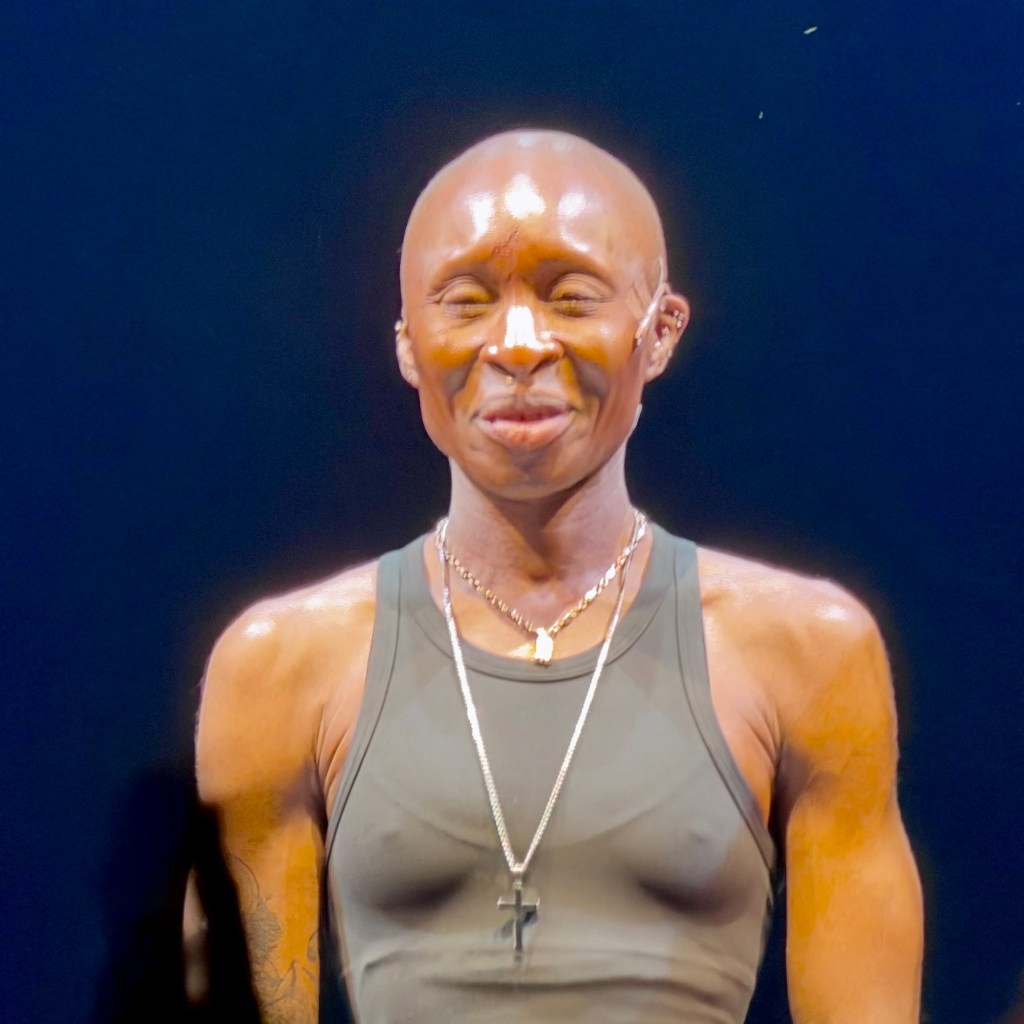
Kip Williams’ Dracula is not a safe night at the theatre. It is a loud, tech-heavy, and an inspiring marathon that asks the audience to look at the stage and the screen simultaneously. Whether you find the cine-theatre style a “fabulously sophisticated” evolution or a “distracting gimmick,” there is no denying the “magnetic” power of Cynthia Erivo. She has returned home not just as a star, but as a titan, carrying 23 characters on her shoulders with a “prowling and predatory” grace. It’s a blood-pumping reimagining that you need to see to believe, just catch it before the undead season ends on May 31st!
 StageAficionado